Daggett County Dog Registration Information
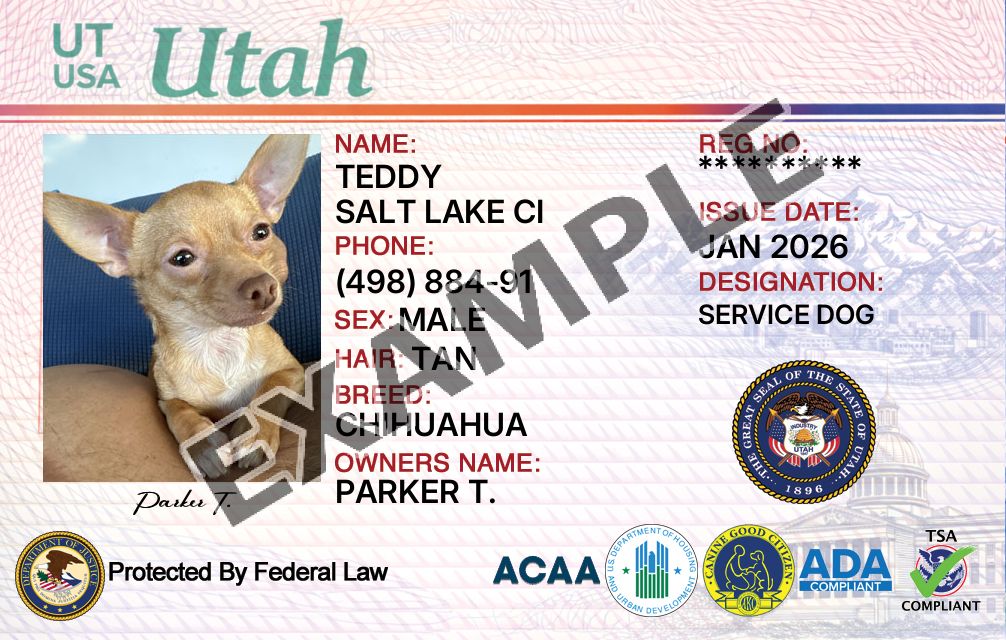
Service Dogs and Emotional Support Animals in Daggett, Utah
If you’re asking where do I register my dog in Daggett County, Utah for my service dog or emotional support dog, the key point is this: service dogs and emotional support animals (ESAs) are not “registered” with the county in a way that changes their legal status. What most residents actually need is a dog license in Daggett County, Utah—a local license issued under county rules—plus up-to-date rabies vaccination documentation.
This page explains where to register a dog in Daggett County, Utah by contacting official local offices, how licensing works locally, what rabies requirements typically apply, and how a dog license differs from service dog rights and ESA rules.
Where to Register or License Your Dog in Daggett County, Utah
Licensing and enforcement are usually handled locally. Below are example official offices that residents commonly contact for licensing questions, animal control dog license Daggett County, Utah enforcement issues, dog-at-large concerns, and rabies/quarantine guidance. If an office does not directly issue licenses, they can typically direct you to the correct local process.
Official Offices (Examples)
| Office | Address | Phone | Hours | |
|---|---|---|---|---|
|
Daggett County Clerk
County administration (local guidance & referrals)
|
95 North 1st West Manila, UT 84046 |
(435) 784-3154 | [email protected] | Not listed |
|
Daggett County Sheriff’s Office
Animal control enforcement, impound, dogs at large
|
95 North 1st West Manila, UT 84046 |
(435) 784-3154 | Not listed | Not listed |
|
Tri-County Health Department (Serving Daggett County)
Rabies & public health guidance
|
Address not listed for Daggett office/clinic on source page | (435) 247-1177 | Not listed | Not listed |
Overview of Dog Licensing in Daggett County, Utah
What “registering your dog” usually means
In everyday terms, “registering” a dog typically means getting a local dog license. In Daggett County, local ordinance requires a license to own/keep/harbor a dog in the county and describes an annual licensing cycle, tags, and penalties for unlicensed dogs. This is the practical answer to where to register a dog in Daggett County, Utah: you’re usually looking for the local office that issues the county (or local jurisdiction) license and tag.
Why local licensing matters (even for service dogs and ESAs)
A dog’s role—pet, service dog, or emotional support animal—does not automatically replace local licensing requirements. A dog license is used for identification, reunification if your dog is found, and enforcement of animal control rules (like dogs at large, nuisance complaints, and impound procedures). When residents search for animal control dog license Daggett County, Utah, they’re usually trying to confirm which local office handles licensing and what documentation is required.
Rabies vaccination and public health
Rabies prevention is a public health priority in Utah, with statewide guidance and local health department involvement in exposure assessments and quarantine decisions. In practice, most local licensing programs require proof of current rabies vaccination before a license and tag are issued. If your dog bites someone or may have been exposed to rabies, you may be directed to coordinate with the local health department for next steps.
How Dog Licensing Works Locally in Daggett County, Utah
Local rule: licensing is required and renewed annually
Daggett County’s animal control code states that it is unlawful to keep a dog in the county without first obtaining a license, and it describes an annual licensing requirement (with licensing typically secured each year during January) and a fee set by the Board of County Commissioners. The code also describes a required tag that must be worn and the potential for impoundment if a dog is unlicensed.
New residents and dogs brought into the county
If you move into Daggett County or bring a dog into the county, local rules provide a compliance window (a limited number of days) to meet the licensing requirement. If you’re new to the area and wondering where do I register my dog in Daggett County, Utah for my service dog or emotional support dog, start by calling an official office listed above and ask: (1) which office issues the license for your address, (2) what documents you must bring, and (3) how renewals are handled.
Tags, identification, and animal control enforcement
Local rules describe the issuance of a collar tag at the time of licensing and require that it be worn. If a dog is found unlicensed, it may be impounded, and the owner may need to provide proof of ownership and pay applicable fees/fines and the license fee to reclaim the dog. The county code also describes “dogs at large” restrictions and gives the Sheriff’s Office authority to impound dogs running at large.
Typical licensing steps (what to expect)
- Confirm the correct licensing jurisdiction for your physical address (county vs. any local jurisdiction that may administer licensing).
- Prepare documentation (most commonly rabies vaccination proof; sometimes proof of residency; and your ID).
- Pay the licensing fee set by the applicable local authority.
- Receive a license/tag and keep the tag attached to your dog’s collar as required.
- Renew as required (often annually).
Service Dog Laws in Daggett County, Utah
What makes a dog a “service dog” (and what does not)
A service dog is generally understood as a dog individually trained to do work or perform tasks for a person with a disability. The dog’s legal status comes from disability law and the dog’s training to perform specific tasks—not from a paid “registration,” a vest, an ID card, or an online certificate.
Do service dogs need a local dog license?
In many places, service dogs must still comply with neutral local animal control rules like licensing, rabies vaccination, and leash/dog-at-large requirements. So if you’re searching for a dog license in Daggett County, Utah for a service dog, the practical answer is the same as for any other dog: you’re typically licensing the animal locally and keeping vaccination documentation current.
Public access vs. animal control rules
Service dog public access rights are different from licensing. A dog license is about local identification and enforcement. Even a legitimate service dog can be subject to behavior standards and control requirements. For example, local rules restricting dogs at large focus on restraint/control and complaints, and enforcement authority may involve animal control and the Sheriff’s Office.
Best practice for owners in Daggett County
- License your dog through the appropriate local process.
- Keep rabies proof handy (paper or digital copy).
- Maintain control (leash/voice control as applicable and safe).
- Use training documentation for yourself (optional) to stay organized—just remember it is not the same as legal “registration.”
Emotional Support Animal Rules in Daggett County, Utah
What an emotional support animal (ESA) is
An emotional support animal is generally an animal that provides comfort or support that helps with a person’s disability-related needs. ESAs are most commonly relevant in housing contexts (reasonable accommodations), not general public access.
ESAs are not “service dogs” and are not granted the same public access
An ESA does not automatically have the same public access rights as a trained service dog in restaurants, stores, or other public places. If you’re trying to “register” an ESA, be cautious: many third-party registries are not official and are not required to establish an ESA accommodation. What you usually still need locally is the same baseline requirement: a dog license in Daggett County, Utah (where applicable) and up-to-date rabies vaccination.
How ESAs and licensing intersect locally
Local licensing is typically status-neutral. Whether your dog is a pet or an ESA, licensing supports animal control operations, helps return lost dogs to owners, and ties the dog to rabies documentation when required by the licensing program. If you’re asking where to register a dog in Daggett County, Utah for an ESA, the most accurate approach is: license the dog locally and keep your separate ESA documentation for housing discussions as needed.
Housing tip (practical, not legal advice)
If a landlord or property manager requests information for an ESA accommodation, keep communications polite and organized, and be ready to provide reasonable documentation related to the disability-related need—while also maintaining local compliance (license/tag and vaccination documentation) just like any other dog.
Frequently Asked Questions
Register A Dog In Other Utah Counties
Select your county below to get started with your dog’s ID card. Requirements and license designs may vary by county, so choose your location to see the correct options and complete your pup’s registration.
- Beaver County Dog Registration
- Box Elder County Dog Registration
- Cache County Dog Registration
- Carbon County Dog Registration
- Davis County Dog Registration
- Duchesne County Dog Registration
- Emery County Dog Registration
- Garfield County Dog Registration
- Grand County Dog Registration
- Iron County Dog Registration
- Juab County Dog Registration
- Kane County Dog Registration
- Millard County Dog Registration
- Morgan County Dog Registration
- Piute County Dog Registration
- Rich County Dog Registration
- Salt Lake County Dog Registration
- San Juan County Dog Registration
- Sanpete County Dog Registration
- Sevier County Dog Registration
- Summit County Dog Registration
- Tooele County Dog Registration
- Uintah County Dog Registration
- Utah County Dog Registration
- Wasatch County Dog Registration
- Washington County Dog Registration
- Wayne County Dog Registration
- Weber County Dog Registration